
Charlotte, North Carolina · Est. 1891
Dilworth.
Charlotte's first
streetcar suburb.
Deep porches, hundred-year-old oaks, a main street you can walk to, and a park at the center of it all. This is the complete, carefully researched guide to living in, buying in, and building in Dilworth.
Peters businesses
When you're ready to move from research to a real house.
Nicholas and Miriam Peters publish this Dilworth guide alongside their real estate, home building, design and technology businesses. The businesses listed here are theirs. They are not independent recommendations.
Dilworth houses aren't all alike. Some sit inside a local historic district, where exterior changes need city review. Many others don't. Check the rules for your specific parcel before you plan any changes. How to check.
Buying or selling a Dilworth house
Planning a major renovation, addition or new build (only where the parcel permits)
Interiors for a house built in the 1910s or 1920s
The family also publishes Peters Signature Travel and 57 other websites, most of them guides to other Charlotte-area neighborhoods.
The short version
A neighborhood built for walking, a century before anyone called it that.
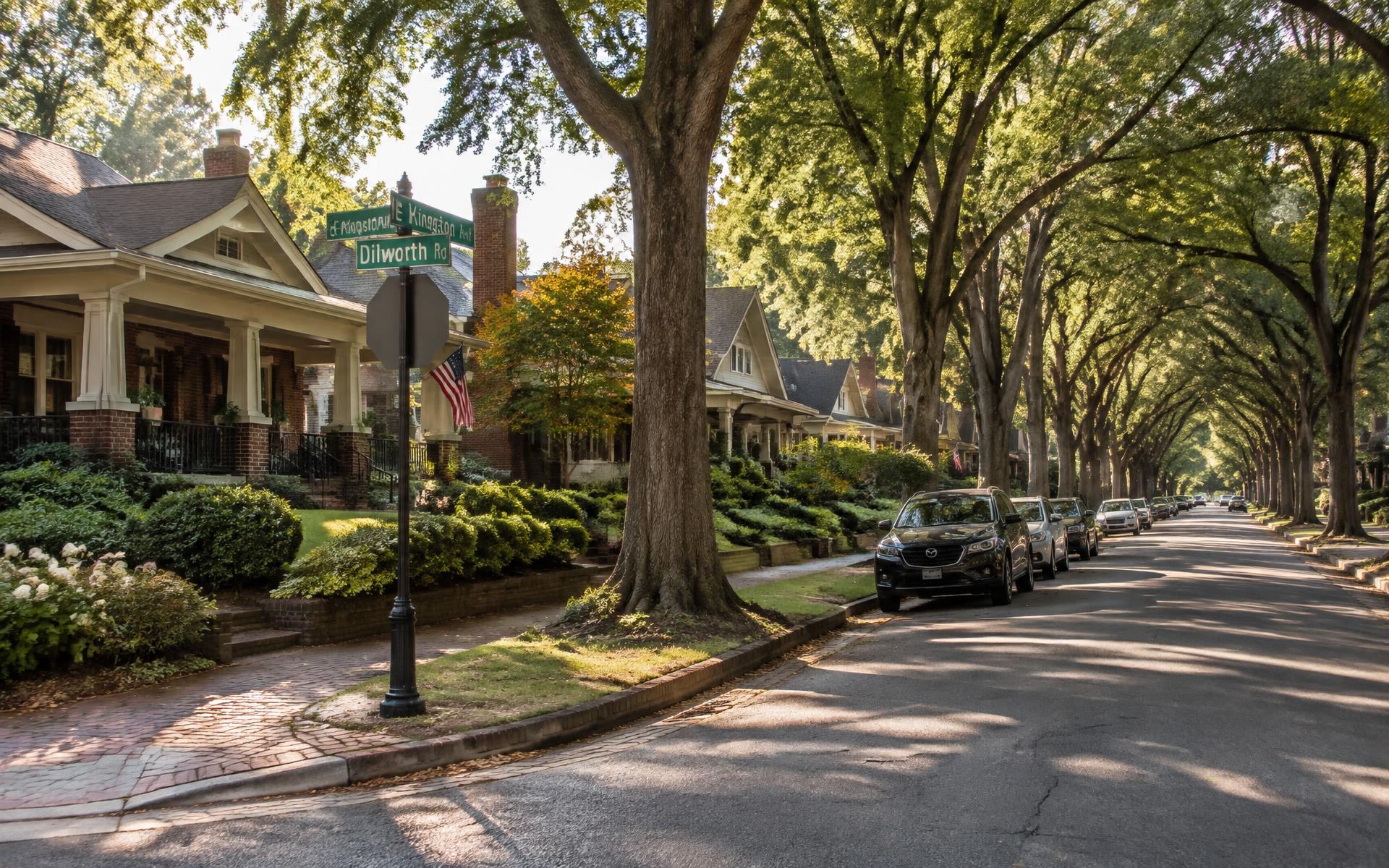
In 1891, Edward Dilworth Latta ran an electric trolley line south from the square and sold lots along it. It was a speculative gamble — Charlotte was a small textile town and nobody had yet lived a mile from where they worked. The gamble worked, and the street grid he platted is still the reason Dilworth feels the way it does: short blocks, continuous sidewalks, a public park at the middle, and houses turned to face the street with porches rather than garages.
What followed was three decades of extraordinary residential architecture — Queen Anne cottages giving way to Craftsman bungalows, then Colonial and Tudor Revival houses as the neighborhood expanded south toward what is now Freedom Park. Most of that stock survives. It survives because residents fought for it, and because much of the neighborhood is now a local historic district with design review over what happens to the street-facing side of a house.
Today Dilworth is one of the most sought-after addresses in Charlotte, and one of the more complicated ones to buy and renovate in. That complexity is exactly what this guide exists to explain.
1891
Platted
Charlotte's first planned streetcar suburb.
~1 mi
To Uptown
Most of the district is inside a mile of the central business district.
1900s–30s
Core housing stock
Bungalows, Queen Anne cottages and Revival-era houses.
Design review
Historic district
Exterior changes reviewed before permitting in much of the neighborhood.
Explore
Six ways into the neighborhood
Every chapter is researched independently and cited. Start wherever your question is.

History
A streetcar suburb since 1891

Architecture
The bungalow belt

Real estate
The market and the housing stock

Main street
East Boulevard, block by block
Street by street
Every street in Dilworth

Green space
Latta Park and Freedom Park

Schools
Public, magnet and independent
The map
How Dilworth actually fits together
Filter by dining, parks, transit or schools and see the walking relationships that make this neighborhood work.
Interactive
Dilworth at a glance
A schematic of the district: the main street, the parks, the rail, the schools. Filter by what you care about, then tap a point for context.
Parks & greenway
Latta Park
Charlotte's original 1891 pleasure garden — playground, tennis, dog-walking loop and summer concerts.
Read the Latta Park guideSchematic diagram — relative positions only, not to scale and not a survey. For parcel boundaries use Mecklenburg County POLARIS 3G.

Daily life
A neighborhood that still runs on porches
The clearest thing about Dilworth is what happens between five and seven in the evening. Dogs come out. So do strollers, and folding chairs, and the neighbors who have been on that block since the eighties. It is a neighborhood where people know one another's houses by their porch color.
That texture is not an accident of charm. It is what happens when the sidewalks connect, the blocks are short, the porches face the street, and there is somewhere worth walking to at the end of them.
I came to look at a house. I ended up walking the whole neighborhood twice and eating dinner on East Boulevard, and by Sunday I had stopped comparing it to anywhere else in Charlotte.
Trusted locally
The people we recommend
Renovating a hundred-year-old house inside a design-review district rewards specialists. These are the firms we introduce readers to — and they sponsor this guide, which we disclose on every page they appear.

Eat
Where to eat in Dilworth
Compare
Dilworth vs. Myers Park, South End & Sedgefield
Relocating
Moving to Charlotte
Frequently asked
Dilworth, answered
The questions we're asked most, each answered with the primary source behind it.
Where exactly is Dilworth in Charlotte?
Dilworth sits immediately south of Uptown Charlotte, bounded roughly by I-277 and Morehead Street to the north, the light rail and South Boulevard corridor to the west, Kenilworth Avenue to the east, and the Freedom Park and Park Road area to the south. It is one of the closest-in residential neighborhoods to the central business district, which is why most residents describe their commute in minutes rather than miles.
What makes Dilworth historically significant?
Dilworth was Charlotte's first streetcar suburb, laid out in 1891 by Edward Dilworth Latta's Charlotte Consolidated Construction Company. The trolley line made it possible for people to live away from the city center for the first time, and the resulting grid of tree-lined streets, deep porches and a central park set the pattern for every Charlotte neighborhood that followed.
Is Dilworth a local historic district?
Much of Dilworth is designated as a local historic district, which means exterior changes visible from the public right of way go through design review by the Charlotte Historic District Commission before a permit is issued. Boundaries and rules are specific, so confirm the status of an individual address with the Commission before you plan any exterior work.
Source: Charlotte Historic District Commission — Dilworth design standards
What kinds of homes are in Dilworth?
The core housing stock is early-twentieth-century: Craftsman bungalows, Queen Anne and Victorian cottages, Colonial Revival and Tudor Revival houses, plus four-squares. Alongside them are careful renovations, sympathetic new construction on infill lots, and pockets of condominiums and townhomes closer to the light rail and East Boulevard.
Source: City of Charlotte Unified Development Ordinance (2023)
Is Dilworth walkable?
Unusually so for Charlotte. The 1891 grid gives short blocks and continuous sidewalks, East Boulevard concentrates dining and services within the neighborhood itself, Latta Park sits in the middle, and the Rail Trail and Blue Line put South End and Uptown within an easy walk or ride from much of the district.
Which schools serve Dilworth?
Dilworth is served by Charlotte-Mecklenburg Schools, with Dilworth Elementary as the traditional neighborhood elementary and assignments for middle and high school varying by address. CMS also runs magnet programs that draw from across the county, and several well-known independent schools sit nearby. Always verify current assignment by street address with the CMS locator, since boundaries are revisited periodically.
How does Dilworth compare with Myers Park or South End?
Myers Park is grander and more suburban in feel, with larger lots and estate-scale houses. South End is denser, newer and more nightlife-driven, dominated by apartments and adaptive reuse. Dilworth sits deliberately between them: historic single-family houses on walkable blocks with a real main street, which is why it attracts buyers who want character without giving up walkability.
Can you build a new house or add on in Dilworth?
Yes, but within limits. New construction and additions in the local historic district are reviewed for scale, massing, materials and street-facing character, and the city's development ordinance governs setbacks, lot coverage and tree protection. Successful projects are designed for review from the beginning rather than redesigned after a rejection.
Source: Charlotte Historic District Commission — Dilworth design standards
Sources & verification
We cite primary sources so you can check our work. Figures, assignments and regulations change — confirm anything you plan to rely on directly with the agency below.
- Charlotte-Mecklenburg Historic Landmarks Commission
- Charlotte Historic District Commission — Dilworth design standards
- Mecklenburg County POLARIS 3G parcel viewer
- Charlotte-Mecklenburg Schools school locator
- Mecklenburg County Park & Recreation
- Charlotte Area Transit System — LYNX Blue Line
- Mecklenburg County Assessor's Office property records
- City of Charlotte Unified Development Ordinance (2023)
Next step
Planning a move, a purchase or a renovation?
We'll point you to the right chapter — or introduce you to a builder, broker, designer or integrator who works in this neighborhood every week.